Search This Blog

Sunday, 11 November 2012

A Month On: the final poem of a trilogy


                         Welcome!
Absent - one rosella
Others may disagree, but I think this spring in the Adelaide Hills has performed a rare show of warming up gradually. This is a pleasant and wondrous phenomenon. Typically, Adelaide’s weather seems to know little moderation; it’s hot as, or it’s cold (by comparison). One can never adapt because the range varies so much, often changing the maximum temperature by 10 degrees Celsius from one day to the next, in either direction. Thank you, Spring, for a gentle introduction to the heat and dryness of a Mediterranean summer downunder.

The final poem of the trilogy 'The futility of attempting capture' is here unveiled. I have added the first two poems (in grey) before it so that you can easily read the whole set. Scroll down to the new one if it all seems too familiar!

Calling card
This morning I communed with a rosella
through the dusty glass of my window.
He perched on a swaying twig of bottlebrush,
seeking a companion
with the ringing call of his kind,
glowing red and orange in the sunshine.
Then he turned an eye towards me
and began bobbing and chucking like a budgie,
inquiring.
With gentle movement, talking and singing,
I sent him on his search with a blessing.

My friend rosella was, vividly tangible,
God’s calling card,
for I, too, had been looking for company,
responding to the song of the creator
and listening, heart open, to his words
as he blessed me on my way.


‘Oh Bobby’
I called him Bobby after that first visit
when he’d warmed my heart
and charmed my imagination with his antics of bird curiosity.
He returned to that lichened twig by my window
several times a day
and I determined to capture it,
to celebrate our friendship
with a photograph, framed
neatly by the window (now washed).

Friendship, huh.

‘Oh Bobby’ became the wail of my longing
as all that remained of every attempt –
me creeping close with the camera poised
while he watched with one eye,
twitched and flew before the shutter closed.
The best I managed was a blurry shot, claimed
in triumph
and accidentally erased the same day –
all that remained was the flash of colour as he retreated,
to return another time with
his luring call and practised nonchalance.


A month on
I imagined he was alone
because he was seeking, waiting
for the right one in this season
of mating and ritual.
Daily I heard the ringing ‘pip, pip’ of the mate-call,
daily I caught up the camera
to frame him in his rosella glory
arrayed just out of reach.
The calls sounded
and I stopped whatever I was doing:
‘This time…’

I have become the lover
at the end of your siren song,
You, wild and free, calling
Me, captive to the intent of a perfect picture, answering.
But your only reply
is that lichened twig where we first met,
quivering with your absence.

I'd love to read your stories of communing with wild creatures, so why not post a comment with your own story here?

Until next week…
Claire Belberg


Saturday, 3 November 2012

Lucky Beanie


Welcome!

Already the grass is drying out in the absence of rain. As much as I enjoy the weather warming up (and it has done this quite gently this year, unlike the typical skip-the-middle-numbers temperature spikes), the yellowing as the season marches towards summer is a bit depressing. It gets harder and harder to water the garden enough (while trying to be responsible with our limited water resources), and the risk of bushfire increases. Still, if the possums and parrots don’t get them first, we do have wonderful summer fruits to look forward to. It’s difficult to be too sad about summer.


The story for this week is a quirky play on a song my daughters sang as a warm-up exercise for choir rehearsals. Let me know if you recognise the song!

Lucky Beanie
I pressed the end-call button on my mobile before I let myself go.
            'I did it! I got myself a gig at the Crooked Crown. It's my break, Seona! Do you know who hangs out at the Crown? Talent spotters for record companies, that's who!' I whooped and danced around our flat like a tribal, singing an impromptu tribute to my lucky gig beanie. I just knew that beanie would give me the edge I needed to become a famous singer-songwriter.
            Seona just smiled, the crinkles at the corner of her eyes revealing her genuine, otherwise unexpressed, pleasure. 'Oh, and thanks for the idea,' I mumbled. Seona doesn't say much, but she's so smart, what she does say is worth more than I can think in a week.
            I stayed up late that night finishing off a song I thought I'd debut at the gig. I spent the next two weeks planning and rehearsing my bracket. I made flyers and handed them out to my friends, hoping they'd turn up to boost the friendly numbers. I even told my parents and then had to invent a good line to prevent them from coming. I knew they'd be proud of me, but performing to old folk whose idea of real music is a violin virtuoso in a painfully silent room doesn't bring out my best.
            I should've realised the dream was doomed by the way everything rolled along so easily until Friday.
            On Friday I thought I'd pop by the hotel to suss it out. It's one weird place.   While I was there, I had a chat with the manager who, after some checking and rechecking, finally accepted that it was me who would be playing between nine and ten the next night, and that, in fact, I would be playing a twelve-string guitar and singing original songs, not doing a stand-up comedy act accompanied by a trombone. It's all good, I say.
            At home I pulled out my guitar my favourite, still-paying-the-mortgage guitar to find pale green and black slime all over the fretboard and dropping in lumps into the sound hole. Ah yes, the snack I'd packed for my last band practice and forgotten to eat. Fortunately avocado doesn't smell too strongly.
            Yep, it's all good. Then, as I cleaned the strings, the top E-string snapped. Hurried phone calls to the guitar-playing friends since the shops had shut by then. They'd open the next morning to find a large number of guitarists keen on buying spare E-strings because it turned out that none of them had one. And to make sure they didn't sell out before I rocked up, I camped on the doorstep from six in the morning. Only got moved on twice by the police and once by a drunk who thought I looked like his last landlady.
            By 9:03 I'd been told that the distributors were currently having difficulty supplying steel strings. At 10:03 I found the spare E-string I suddenly remembered I had. Why I had hidden it in a hiking boot remains a mystery. It's just a good thing I tipped up all my shoes in order to find my beanie.
            You've got to understand about my lucky beanie. It's as ugly as heck, murky brown wool mixed with something like sludge green in a rough fibre. It was once my Great Aunt Farula's. I remember the way her eyes sank into the layers of wrinkled skin covering her skeletal head and the beanie she always wore, which I studied intently to avoid looking at her face. Somehow I knew when I inherited it that it was going to change my life.
            I hunted through all my shoes, all my drawers, the dirty washing, the ironing pile and the bags of clothes waiting to be sent to the refugees. I found the much-needed E-string, but not my beanie.
            It was getting dark. I sat in the cramped lounge of our third floor flat, looking around the room at every picture, poster, photograph and ornament as if they might turn into the mysteriously absent beanie. I was out of ideas. I was working hard to push aside the terrifying thought of appearing at the Crown, on this, the night of my big break, minus the beanie. Deep, agonised silence. My thoughts had collapsed into a soggy formless lump.
            Who knows how long I might have remained in this state if my beanie had not inched its way, with jerks and jumps, before my initially unseeing eyes. It was most of the way to the kitchen before eternity thawed into a distinct now.
            I pounced. My beanie screeched. I picked it up. It shuddered. I dropped it. My beanie had never behaved this way before. In fact, it had never behaved. What had gotten into it? I flipped it over and stared, uncomprehending.
            Clinging to the inside was a jelly-like purple thing with tiny nose, mouth, limbs and claws. It quivered but it wouldn't fall out no matter how hard I shook the beanie. I turned the beanie inside out; the purple creature stretched to cover what was now the outside. How dare it take over my lucky beanie! I put it under the tap, first the cold, and then, with a rush of jealousy, the hot water. It made no difference, other than the thing spraying me like a dog shaking to get dry.
            The time was nearing seven. I had to eat, dress, and catch a bus to the hotel by eight-thirty. I left the beanie on the kitchen bench while I prepared some food I had no appetite to eat. I wondered whether Seona would come home, turn up at the hotel, or spend the evening in the library as usual. I cooked her some fried rice anyway.
            I made a crucial decision while I was eating: I would wear the beanie, even with the purple creature inside if it came to that. The beanie hadn't moved for ages. Maybe the thing slept. Maybe it had gone when I wasn't looking. Anyway, I didn't have to wear the beanie until I played, so I stuffed it into my backpack.
            By 8:35 I was at the Crooked Crown. Not a lot of people yet. Which ones were the talent scouts? Couldn't tell, so I searched for faces of friends. Couldn't see any. I dumped my gear at a table near the corner where a couple of guys were playing bass guitars and singing tunelessly. I sat at the bar with a Coke, taking in the smell of stale beer and the distant clatter of poker machines, trying to tune into the mood of the place. Not much mood; everyone was ignoring the musicians. Good, I thought, they'll be fresh for me. I couldn't wait to get started.
            When I returned to my gear, I thought for a moment the backpack had moved. I intercepted a look from one of the bass players, whose gaze returned to the pack just as it lurched towards him. I looked inside, acting nonchalance. Everything seemed as I'd left it. The beanie was still and silent again.
            The guys finished their bracket to a few slow claps, packed up and pushed through the drinkers. I took a deep breath, said a prayer, and moved into the corner to set up. A couple of friends turned up, and sat at my table.
            'Hey, Jodie,' boomed Sasha. 'Looks like Mara's about to play. Should be a great show!' He winked at Jodie.
            I stepped up to the mic quickly. 'Good evening, all. My name's Mara Simbaya, and I'm going to entertain you with some of my original songs. I hope you'll enjoy them. I'll be around afterwards for a chat. So lean back and feel the flow of good vibes.' I pulled the beanie over my dark hair, strummed some chords and launched into an old favourite. It felt good, and the crowd settled to a quiet hum of contentment, while Sasha and Jodie clapped and cheered.
            As my confidence gained momentum and the audience seemed to be eating out of my hand, I tried a few one liners as I moved between songs. They went down well. But in my fourth song the mood shifted. The crowd were watching me closely but they seemed distracted. My song wasn't reaching them. Sweat trickled from my forehead into my eyes; my confidence leaked away. How had I lost my audience? And my best songs were yet to come.
            'Oh my God!' Jodie screeched. 'It's moving! Look at the beanie!'
            Her words drew me out of a desperate focus on the song to the strange sensation on my head. I realised it had been happening for a while. My hair was being nibbled and tugged, accompanied by a squelching sound. I quit strumming to peal the beanie off, intending to throw it aside. It wouldn't budge. I finished the song, and tried some banter into the microphone while I wrestled with my beanie, subtly at first, then with growing urgency. It was beginning to hurt.
            My audience was laughing, clapping and throwing comments to me. Sasha and Jodie had slunk away. I had attention; I wished I was invisible.
            Seona! I saw her at the edge of the crowd. I tried to telegraph her with my eyebrows to come and help me. She saw, watched some more, and then began an infuriatingly calm progress towards me. Nobody rushes Seona. When she reached my side she whispered, 'It's a purple people-eater. Loves hair. Very rare. I borrowed it from the laboratory but I've got to return it on Monday.' She slipped her hand under the back of the beanie, flicked, and removed the beanie without too much of my remaining hair being pulled out. I was free.
            I could feel the heat of the lights on a patch near my crown. I resolutely continued my bracket, but I had no energy for performing, and the listeners drifted away. The last twenty minutes dragged. I couldn't satisfy the half-hearted calls for jokes; I couldn't think. When the feature band of the night moved to take over, I fled to the bathroom. I couldn't see it but I felt a bald patch on the top of my head, and the slight dents of teeth marks in the tender flesh.
            I tried to sneak out the back way, but the manager caught me by the kitchen door.
            'It might have worked better with a trombone,' he said, his droopy eyes flicking past mine, cold as a lizard's. I left without answering. What can you say when your dream dies at birth?
* * *   
That was last week. Last week, last year, time frozen in eternal wastelands.
            I visit Seona at her laboratory on my way to the city, offering to donate the traitorous beanie to support her research on irritating jelly-like creatures.
            'So what's your plan?' Seona asks as she stares at the beanie, which still has a skein of my crinkly hair attached to it. I can see her mind is somewhere else.
            'Some woman rang and asked me to meet her at the Blue Fish Café for lunch. She didn't say much, just said she had an offer she wanted to put to me. No idea what it's about, but I haven't got a life anymore, and, hey, it's a free lunch.'
            Seona is with me now. She's grinning. She knows something I don't so what's new? Her smile stirs hope in me though.
She offers me the beanie. ‘You’ll be needing this, Mara.’  

Until next week…
Claire Belberg

Saturday, 27 October 2012

'Oh Bobby'

                   Welcome!
gelder roses

The garden is flourishing this spring. Blooms are larger, more voluptuous than they have been for some years. I would like to think it was because of my attentions, but I suspect it’s mostly two years of adequate rains and milder temperatures. The gelder roses have never been such an impressive size. I hope the conditions continue to favour my new plants, replacements for the many we lost because of drought and water restrictions. If I have chosen well and been faithful in establishing them, the new plants will thrive when the next drought comes – an Australian certainty.

This week we have the second poem of the trilogy, ‘The futility of attempting capture’. The first poem is also shown (in grey) so that you can see the first two parts together. Stay tuned for the final in a fortnight (and an unrelated story next week, for those who prefer fiction to poetry).

Calling card
This morning I communed with a rosella
through the dusty glass of my window.
He perched on a swaying twig of bottlebrush,
seeking a companion
with the ringing call of his kind,
glowing red and orange in the sunshine.
Then he turned an eye towards me
and began bobbing and chucking like a budgie,
inquiring.
With gentle movement, talking and singing,
I sent him on his search with a blessing.
                 
My friend rosella was, vividly tangible,
God’s calling card,
for I, too, had been looking for company,
responding to the song of the creator
and listening, heart open, to his words
as he blessed me on my way.


‘Oh Bobby’
I called him Bobby after that first visit
when he’d warmed my heart
and charmed my imagination with his antics of bird curiosity.
He returned to that lichened twig by my window
several times a day
and I determined to capture it,
to celebrate our friendship
with a photograph, framed
neatly by the window (now washed).

Friendship, huh.

‘Oh Bobby’ became the wail of my longing
as all that remained of every attempt –
me creeping close with the camera poised
while he watched with one eye,
twitched and flew before the shutter closed.
The best I managed was a blurry shot, claimed
in triumph
and accidentally erased the same day –
all that remained was the flash of colour as he retreated,
to return another time with
his luring call and practised nonchalance.

Until next week…
Claire Belberg
Saturday, 20 October 2012

Local Colour

                         Welcome!
broody Izzy

Some days seem very long. I love daylight saving and the light in the evenings, and the fact that until the end of December our days will get longer. But today’s length is increased by sorrow. The death of a young man, suddenly last night, has us all in the shock that makes a dragging timelessness. Oddly, our chicken shares the malaise, but in her case it’s because we discovered the secret egg cache – she’s gone broody. So, just like us, she stands and stares, oblivious to her surroundings.

Farewell, 'Little Sam'. Cook up a feast in heaven.

Our story this week is a different matter, a quietly colourful contemporary piece.


Local Colour

It looked like rain, which was a pity because Shirley had set up the courtyard for her afternoon soiree. The garden was looking delightful right now, with azaleas and camellias competing to add the brightest hue. The sullen sky made a perfect backdrop for the gorgeous display but Shirley suspected her guests would not appreciate that artistic detail. With a sigh she returned to the house with the tea tray.
            On the face of it, this was simply an afternoon tea for her friends. But Shirley had a problem, and she hoped that by observing these particular people together, she might find a solution.
            The doorbell rang, and before she could answer it, her friend Anthea let herself in. She entered the kitchen by one door as Shirley walked through another towards the sunroom.
            'What can I do to help?' she asked.
            'Do you think the five of us will fit comfortably in here?' Shirley said. She explained her change of plans. 'At least we can see some of the colour from here.'
            'I love this room,' Anthea replied, with a rapt expression she often wore around Shirley. 'You make everything beautiful inside and out.'
            'Give me a hand with that chair, would you?' Shirley pointed to a dining chair like the one she was carrying. 'Put it on the other side of the table. Thanks.'
            They arranged the chairs around a glass-topped coffee table. Then the doorbell rang again.
            'I'll get it,' Anthea said.
            Shirley put the kettle on, removed her apron, and walked out to greet the next guest.
            'Darling, this is Felipe. You don't mind that I invited him to join us, do you?' Louise did not wait for the reply that Shirley could hardly make without rudeness, and turned to the moustached man just behind her. 'This is Shirley, who I told you all about. She painted that still life in the shop behind the counter.'
            Felipe bowed over Shirley's hand, which gave her the first inkling of why this stranger to Riverlea had suddenly gained Louise's favour. He was well-groomed, probably in his late fifties, with dark eyes, and long black hair tied in a neat pony tail. An arty type, she suspected, adding the second inkling to Louise's presumption. It was odd that people assumed all artists would relate well to each other, as if the act of creativity was a rare bond.
            'Welcome. Come in, come in. Is it raining yet?' Shirley showed them to the sunroom as the first drops darkened the paving stones beyond the window. She settled the three there and collected the kettle from the kitchen. She poured the hot water through the filter into the coffee pot on its portable element, and went to fill the kettle again.
            The doorbell rang. She opened it to find her two remaining guests huddling in the tiny porch in expectation of a deluge. She showed them into the sunroom. Ted was loud enough to fill the room on his own, a factor she had forgotten to take into account.
            Eventually the coffee and tea were brewed, the guests were filling their cups, and the cakes were doing the rounds. Denley had brought another dining chair through and the five guests were squeezed into the small room with Shirley's chair filling the doorway.
            Ted pushed his chair back the little it could move before bumping the wall. 'Here's to Shirley, and her spreading fame. May it bring prosperity to Riverlea.' He waved his orange teacup in the air. It looked like it belonged to a child's set in his meaty hand. So far, so good.
            'No, no, Ted. This isn't a civic function, so let's forget the speeches.' Shirley waved him into his seat before taking the remaining cup, a black one, and sitting down to drink her coffee.
            'Everything's a civic function to Ted,' Louise sniped. 'He's trying to turn Riverlea into the business district of Fairbanks. I think,' she said with emphasis, 'the charm of our town is its tasteful specialty stores and olde worlde charm.'
            'Your antique store is very tasteful, madame,' Felipe acknowledged with a smile, taking the red cup. Louise's face lost its tightness and she sat back, clearly pleased.
            'Shirley, your garden has the olde worlde charm Louise mentioned. Maybe the business council should commission you to design some public gardens where that vacant block is next to Turner's,' Denley suggested.
            Ted butted in before Denley had finished his words. 'Shirley's got enough to do already without that. We have plans, you know, for that spot, which I can't go into. Of course, Shirley would do a lovely job with it, for sure.' He stopped, reddening as Shirley gave him a stern look. 'I mean, um, you know, this garden and all her paintings and so on isn't that right?'
            Shirley smoothed over Ted's confusion by offering another round of coffee and tea.
            Denley said, 'So tell me, Felipe, where do you come from? How do you know Louise?' He leaned forward, his usual blue cup in hand. He was an excellent listener.
            Felipe told how his search for a particular piece of cello music had him scouring antique shops. He played cello in an orchestra in the city, and collected rare music.
            'He's a lucky man,' Louise added. She refilled her yellow cup with tea. She did love that colour, thought Shirley with an inner smile.
            Anthea looked puzzled. 'Because he found your shop? Did you have the music?'
            Shirley noticed Felipe's surprised look, quickly covered with an enigmatic smile.
            'No, unfortunately I've never heard of the music. What I meant was, as soon as Felipe walked into the shop, I knew he had an aura of good luck. Surely you can sense it.'
            Shirley wanted to laugh. Louise had a 'gift' which enabled her to identify special people. It was clear from the others' expressions that they had their share of stories, as she had, about Louise's 'special' people.
            Felipe was protesting as Ted boomed, 'If he's got friends with money to spend in Riverlea, we'll all agree with Louise.'
            Denley gave Shirley a sympathetic glance and said, 'I think we're the lucky ones to have a musical artist among us.'
            Shirley found Felipe's alternations of expression amusing. She caught his eye and winked. His smile twitched and he took advantage of the view from his position to change the topic.
            'You are the artist of note here,' he commented quietly in his hostess's direction. 'That still life is excellent. I could almost smell the roses. Were they from your beautiful garden?'
            Shirley nodded, but before she could say anything, Ted jumped in. 'Shirley is the face of our latest tourist campaign. She'll bring those big dollars here if anyone can. Wait till you see what she's working on now.' He sat tall and proud, knowing that he and Shirley were the only ones in the room who had any idea of what he was talking about. And Ted had not even seen her current work himself. All Shirley could do was distract them again. She fussed over the table, asking each visitor if they would like another cup of tea or coffee, proffering the remaining cupcakes as insistently as Ted with a potential customer, until in all the bustle, one of the fine china cups, the red one, fell onto the floor and broke with a shattering sharpness. Everyone jumped, and then talked at once.
            Anthea put her favourite mauve cup down with care and fetched the brush and pan, while Denley took the rest of the crockery to the kitchen. Shirley insisted on sweeping up the red shards herself, so Anthea went to help Denley with the washing up. Shirley took the contents of the pan to another room.
            When she returned, Louise commented, 'You can just put another cup and saucer in your collection and no one will be the wiser.'
            Shirley smiled. Her problem was rapidly solving itself. Louise began to describe in detail every item of crockery in her shop and its age and history, while Ted asked Felipe if he liked the horse races. Denley and Anthea did not return until some time later, and Shirley was pleased to notice the flush of colour in her friend's happy face.
            They all left as the clouds cleared and the last of the sun's rays cast a golden glow on the watered village. Shirley saw them to the gate before taking the garden route to her studio, which stood as a separate building just beyond the back door. She turned on the light, and studied the shattered cup, comparing its colour to a large board with an almost completed mosaic design.
            There they all were, in patterned portrait: Ted with an orange tie, Louise in a yellow dress, Denley wearing a blue shirt, Anthea with a mauve ribbon in her hair. All that was missing was the centrepiece, the image of what brought them together. She had had many ideas to represent the community, but until now the right one had evaded her. The best answers were often the simplest.
            'Felipe's red cup. Perfect. I wonder if they'll remember it when it's unveiled.' She fitted the shards of the broken crockery into the space, noting which would need to be cut to form the shape of a large cup in the centre of the scene. She could use the saucer to make more pieces.
            This mosaic was destined to become a permanent fixture on the wall of the civic offices in the centre of Riverlea, at the opening of Ted's latest endeavour to put the village on the tourist map. And one ordinary cup – the colour of the stranger in their midst – would be worked in to create something new and beautiful, celebrating in more ways than one the local colour of Riverlea.


Until next week…
Claire Belberg

Saturday, 13 October 2012

Calling Card

                   Welcome!
bottlebrush flower

The cold is lasting longer than usual this year. I have usually turned my heater off by now, not to be used again until April. Huge power bills notwithstanding, we continue to huddle in front of the heater while the temperature fluctuates like a faulty gauge. I keep reminding myself that the week the rain ceases and the sun unleashes its full power, we’ll all be moaning about how unbearably hot it is, or living in dread of a bushfire. At least our gardens are still green and flourishing, and the smell of smoke does not strike fear. Hooray for the mild seasons!

This week’s poem is the first of a trilogy which I will present over the next five weeks as its component poems, and then put them all together on the last week. I’ll intersperse short stories, as usual, so that those who prefer prose can still find their goodies.

Calling card
This morning I communed with a rosella
through the dusty glass of my window.
He perched on a swaying twig of bottlebrush,
seeking a companion
with the ringing call of his kind,
glowing red and orange in the sunshine.
Then he turned an eye towards me
and began bobbing and chucking like a budgie,
inquiring.
With gentle movement, talking and singing,
I sent him on his search with a blessing.

My friend rosella was, vividly tangible,
God’s calling card,
for I, too, had been looking for company,
responding to the song of the creator
and listening, heart open, to his words

as he blessed me on my way.


Until next week…
Claire Belberg

Saturday, 6 October 2012

His Xanadu

                             Welcome!
my first rose of the season
The Adelaide Hills growing season is typically about six weeks behind the Plains, or at least mine is when compared with a friend’s garden in the northeastern suburbs.  Yellow-flowering plants have a tough time in my garden because they normally prefer full sun and my garden is mostly semi-shade. I really enjoy the yellow roses that add floral sunshine to my view.


The short story this week centres on a garden, a far more planned and perfected one than mine. Nevertheless, all is not as it seems in paradise…

His Xanadu
The air is warm and sweet with the subtle scents of pine and citrus mingled with just the right amount of frangipani. Michael breathes it in slowly, each step of his sojourn in the garden of his dreams bringing a new and exquisite cocktail of fragrance. Living perfume, he says to himself. As glorious, as perfect as the forms of the plants which offered these delectable aromas, as the fluorescence of the flashing wings of parrots fluttering among the delicate marble turrets above him, as the melodious thrummings of the harp strings hidden within those spires.
            How he had laboured to build his dream, the palace to surpass the fabled pleasure-dome of Kublai Khan himself. He had planned, he had sought craftsmen inculcated in the mastery of their trade, sourced the matchless materials, he had watched and inspected, corrected, even demanded parts rebuilt until the dream was satisfied. Now all that remained to be done was to revel in the feast to his senses that unfolded each waking day within his paradise, his Xanadu.
            Scanning again the indescribable beauty all around him, his senses heightened, Michael notices movement on the path ahead of him. Looking more closely, he sees a Rottweiler nosing something on the ground, something small and living. He steps closer, still more conscious of the mellifluous tumble of the crystal stream than the rumble of the dog's response to its toy.
            The dog plays with a mouse. Michael watches absently, his well-ordered paradise still joyful. Suddenly the dog jumps, pouncing almost catlike on the small creature, and Michael is roused from his reverie. The worrying of the great black beast at the defenseless mouse stirs a gust of passion within the man.
            'Leave it alone, Shadow,' he commands. The dog pays no attention.
            The contempt of the dog goads Michael to unpremeditated action. He picks up a stone from the gravel bed next to the path, an angular weight of pink marble which fits comfortably into the crook of his fingers, and throws it at the black dog.
            Now the dog heeds him. An initial yelp, a savage bite, and then its tail between its legs and its nose dripping, it looks at Michael. Waiting.
            Michael's sight is fixed on the spreading drops of bright blood splashing onto the pristine white of the paved path. Worse is the sporadic thrashing of a piece of grey fur at the dog's feet. Michael's stomach clenches.
            He strokes the dog's head. 'Poor Shadow, your snout is hurt.' The dog's tail thumps once, twice. 'Go,' Michael commands. The dog obeys, trotting off in the direction the man points, its nails clipping the stone with a faint 'tick, tick' and a thin trail of blood marking the way.
            There by the misplaced stone lies the mouse, broken by the bite of the surprised dog, neither dead nor alive. It cannot stay, this blot, this insult to beauty, this illogic in the perfectly logical. Michael wipes a suddenly sweaty brow. He is alone. He would have to finish it off. His stomach lurches, the stench of flesh strong in his nostrils, the ugliness of death taking place in the heart of beauty's realm a travesty which offends him to the core. He will not allow himself to be sullied by this act. He tears at a nearby tree, ripping a broad leaf from the bough, splintering the soft timber. He nudges the leaf under the twitching rodent and stands. With carefully controlled steps, avoiding the spattered trail, he walks to the water and throws the malodorous bundle into the singing stream which carries it away, out of sight.
            Michael sighs, a deep breath as of a man recovering from a blow to the chest. It is gone. He takes another path. Yet he feels disturbed. How had his paradise been invaded by such ugliness? What force is at work to disrupt and destroy the glory he has created?
            He paces his paradise, oblivious to its charms as he wrestles with foreboding.


Until next week…
Claire Belberg

Monday, 1 October 2012

Waiting, watching


Welcome!
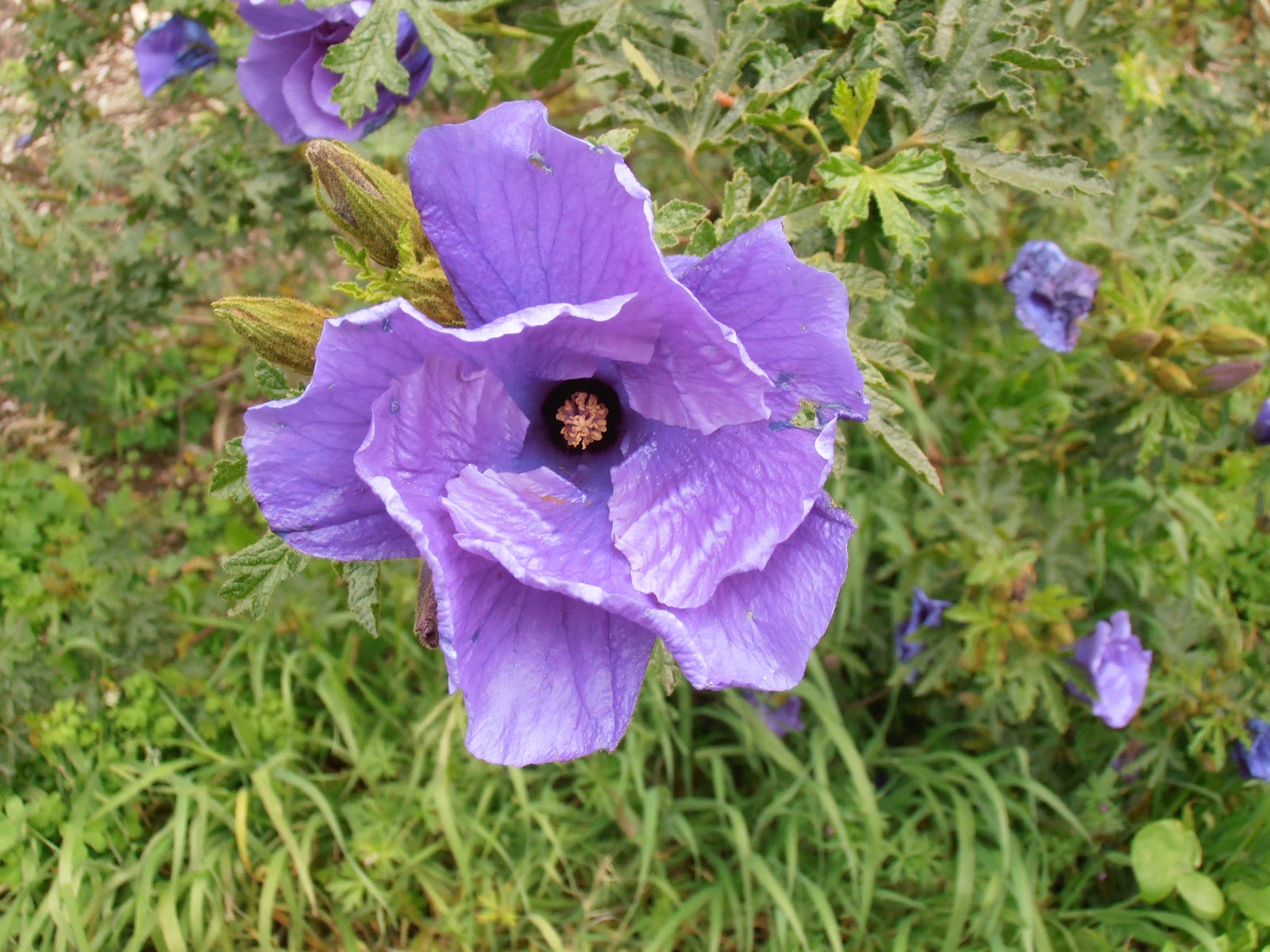
Native hibiscus (alyogyne)
It’s a wonderful thing that the spring-flowering plants don’t change their minds like the weather. Can you imagine if all the flowers of camellia, wisteria, flowering fruits, and Australian native plants like the pictured alyogyne, westringia, prostanthera, etcetera opened on the sunny days and hid on the cloudy ones? Those would be particularly dismal days. But the flowers, having made their choice to bloom, go boldly onward.

These changeable days are for living as much as any other day, but they also seem to say, ‘Wait and watch! Summer is coming.’ The ‘stream of consciousness’ poem below is not about spring but it plays with the same idea, as the name suggests.


Waiting, watching
           
Sun bright
on my paper, pen shadowed
in sharp relief.
            DON'T WALK
Man with sunglasses waiting
at traffic lights, craning
to see the sign,
waiting
jiggling.
Gleaming silver cars stop.
            WALK
towards stunted plants in terracotta
brown-tipped leaves sparse
trapped, collecting fumes
memorial to a million passing cars.
Nature inserted at strategic points.
            DON'T WALK
I chose this place
sitting in the sun, watching.
Eating quiche and salad with a view
justifies spying,
plate glass window my screen
between the world walking by
and my curiosity
            WALK
Old man totters
jaywalking up the road,
just a few steps closer to the post office,
while drivers wait,
tapping.
            DON'T WALK
Sun intensifies through glass,
melts the chocolate waiting for me
on the saucer of vienna coffee.
I eat sporadically,
write quickly to capture
images, and snatches of thought they inspire.
Lettuce and balsamic vinegar
      whatever happened to iceberg and vinaigrette?
Wilted image, names without lyric
now we have rocket
                                    oakleaf           
                                                   mignonette but no crunch.
            WALK
A shopper strides past my window, staring in,
the watcher watched
           
But I was eating, not writing,
wrestling to fork leaves with no crunch.
            DON'T WALK
My mouth waters, waiting as
food falls from my fork, splattering into balsamic puddle,
soggy, tangy carrot
browned off with vinegar.
And the quiche, enticing,
tasteless.
            WALK
Young legs in black stockings,
two girls saunter in unison,
tartan skirts short-changed
like their hours of schooling
this winter's day.
            DON'T WALK
I watch from the corner of my eye;
'uniforms' but
not the same shape
not unformed
not anonymous
my daughters' peers.
            WALK           
Ah, there's the bank's security man
on his lunch break,
sees me
knows me?
Does familiarity compromise integrity?
            DON'T WALK
I remember.
I remember this place
this piece of ground
used to be Penno's Hardware,
boots and wheelbarrows,
meet your neighbours on Saturday morning.
Now a coffee shop changing
ownership as regularly
as the traffic lights its windows frame.
            DON'T WALK
Time
to drink that waiting coffee.
Sure enough, the chocolate
has melted onto the sun-warmed spoon,
wasted on the paper doily.
I lick the spoon,
lick the inside rim of the latte glass,
wasting nothing;
wasting no memories,
holding them in the sun,
tasting them again
more satisfying than coffee and chocolate.
Coffee gone.
Chocolate eaten.
Fingers licked.
Warm in the sun
Lights change, cars stop, people cross.
I watch
            DON'T WALK
I wait to capture time.


Until next week…
Claire Belberg