Search This Blog

Saturday, 13 October 2012

Calling Card

                   Welcome!
bottlebrush flower

The cold is lasting longer than usual this year. I have usually turned my heater off by now, not to be used again until April. Huge power bills notwithstanding, we continue to huddle in front of the heater while the temperature fluctuates like a faulty gauge. I keep reminding myself that the week the rain ceases and the sun unleashes its full power, we’ll all be moaning about how unbearably hot it is, or living in dread of a bushfire. At least our gardens are still green and flourishing, and the smell of smoke does not strike fear. Hooray for the mild seasons!

This week’s poem is the first of a trilogy which I will present over the next five weeks as its component poems, and then put them all together on the last week. I’ll intersperse short stories, as usual, so that those who prefer prose can still find their goodies.

Calling card
This morning I communed with a rosella
through the dusty glass of my window.
He perched on a swaying twig of bottlebrush,
seeking a companion
with the ringing call of his kind,
glowing red and orange in the sunshine.
Then he turned an eye towards me
and began bobbing and chucking like a budgie,
inquiring.
With gentle movement, talking and singing,
I sent him on his search with a blessing.

My friend rosella was, vividly tangible,
God’s calling card,
for I, too, had been looking for company,
responding to the song of the creator
and listening, heart open, to his words

as he blessed me on my way.


Until next week…
Claire Belberg

Saturday, 6 October 2012

His Xanadu

                             Welcome!
my first rose of the season
The Adelaide Hills growing season is typically about six weeks behind the Plains, or at least mine is when compared with a friend’s garden in the northeastern suburbs.  Yellow-flowering plants have a tough time in my garden because they normally prefer full sun and my garden is mostly semi-shade. I really enjoy the yellow roses that add floral sunshine to my view.


The short story this week centres on a garden, a far more planned and perfected one than mine. Nevertheless, all is not as it seems in paradise…

His Xanadu
The air is warm and sweet with the subtle scents of pine and citrus mingled with just the right amount of frangipani. Michael breathes it in slowly, each step of his sojourn in the garden of his dreams bringing a new and exquisite cocktail of fragrance. Living perfume, he says to himself. As glorious, as perfect as the forms of the plants which offered these delectable aromas, as the fluorescence of the flashing wings of parrots fluttering among the delicate marble turrets above him, as the melodious thrummings of the harp strings hidden within those spires.
            How he had laboured to build his dream, the palace to surpass the fabled pleasure-dome of Kublai Khan himself. He had planned, he had sought craftsmen inculcated in the mastery of their trade, sourced the matchless materials, he had watched and inspected, corrected, even demanded parts rebuilt until the dream was satisfied. Now all that remained to be done was to revel in the feast to his senses that unfolded each waking day within his paradise, his Xanadu.
            Scanning again the indescribable beauty all around him, his senses heightened, Michael notices movement on the path ahead of him. Looking more closely, he sees a Rottweiler nosing something on the ground, something small and living. He steps closer, still more conscious of the mellifluous tumble of the crystal stream than the rumble of the dog's response to its toy.
            The dog plays with a mouse. Michael watches absently, his well-ordered paradise still joyful. Suddenly the dog jumps, pouncing almost catlike on the small creature, and Michael is roused from his reverie. The worrying of the great black beast at the defenseless mouse stirs a gust of passion within the man.
            'Leave it alone, Shadow,' he commands. The dog pays no attention.
            The contempt of the dog goads Michael to unpremeditated action. He picks up a stone from the gravel bed next to the path, an angular weight of pink marble which fits comfortably into the crook of his fingers, and throws it at the black dog.
            Now the dog heeds him. An initial yelp, a savage bite, and then its tail between its legs and its nose dripping, it looks at Michael. Waiting.
            Michael's sight is fixed on the spreading drops of bright blood splashing onto the pristine white of the paved path. Worse is the sporadic thrashing of a piece of grey fur at the dog's feet. Michael's stomach clenches.
            He strokes the dog's head. 'Poor Shadow, your snout is hurt.' The dog's tail thumps once, twice. 'Go,' Michael commands. The dog obeys, trotting off in the direction the man points, its nails clipping the stone with a faint 'tick, tick' and a thin trail of blood marking the way.
            There by the misplaced stone lies the mouse, broken by the bite of the surprised dog, neither dead nor alive. It cannot stay, this blot, this insult to beauty, this illogic in the perfectly logical. Michael wipes a suddenly sweaty brow. He is alone. He would have to finish it off. His stomach lurches, the stench of flesh strong in his nostrils, the ugliness of death taking place in the heart of beauty's realm a travesty which offends him to the core. He will not allow himself to be sullied by this act. He tears at a nearby tree, ripping a broad leaf from the bough, splintering the soft timber. He nudges the leaf under the twitching rodent and stands. With carefully controlled steps, avoiding the spattered trail, he walks to the water and throws the malodorous bundle into the singing stream which carries it away, out of sight.
            Michael sighs, a deep breath as of a man recovering from a blow to the chest. It is gone. He takes another path. Yet he feels disturbed. How had his paradise been invaded by such ugliness? What force is at work to disrupt and destroy the glory he has created?
            He paces his paradise, oblivious to its charms as he wrestles with foreboding.


Until next week…
Claire Belberg

Monday, 1 October 2012

Waiting, watching


Welcome!
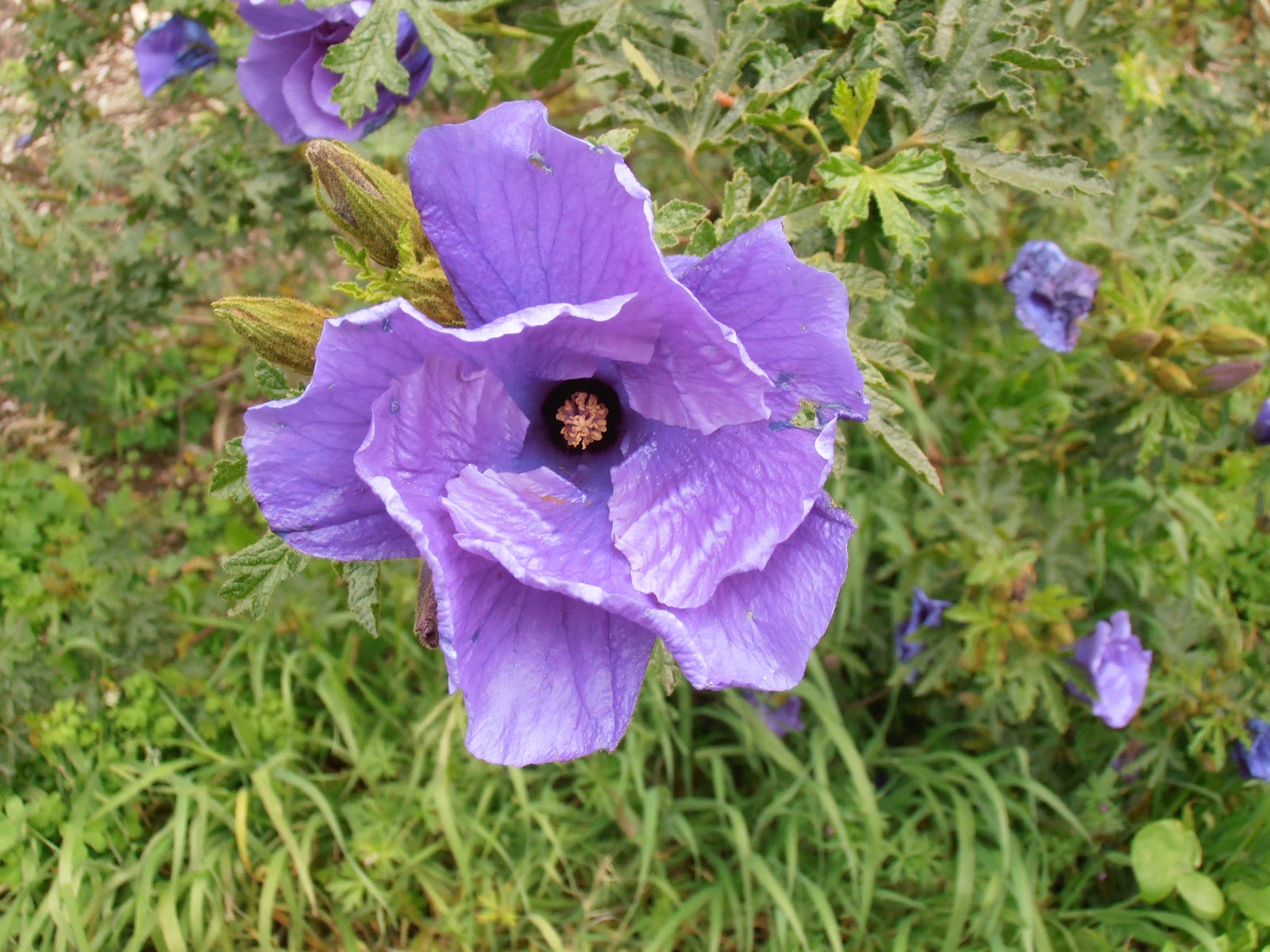
Native hibiscus (alyogyne)
It’s a wonderful thing that the spring-flowering plants don’t change their minds like the weather. Can you imagine if all the flowers of camellia, wisteria, flowering fruits, and Australian native plants like the pictured alyogyne, westringia, prostanthera, etcetera opened on the sunny days and hid on the cloudy ones? Those would be particularly dismal days. But the flowers, having made their choice to bloom, go boldly onward.

These changeable days are for living as much as any other day, but they also seem to say, ‘Wait and watch! Summer is coming.’ The ‘stream of consciousness’ poem below is not about spring but it plays with the same idea, as the name suggests.


Waiting, watching
           
Sun bright
on my paper, pen shadowed
in sharp relief.
            DON'T WALK
Man with sunglasses waiting
at traffic lights, craning
to see the sign,
waiting
jiggling.
Gleaming silver cars stop.
            WALK
towards stunted plants in terracotta
brown-tipped leaves sparse
trapped, collecting fumes
memorial to a million passing cars.
Nature inserted at strategic points.
            DON'T WALK
I chose this place
sitting in the sun, watching.
Eating quiche and salad with a view
justifies spying,
plate glass window my screen
between the world walking by
and my curiosity
            WALK
Old man totters
jaywalking up the road,
just a few steps closer to the post office,
while drivers wait,
tapping.
            DON'T WALK
Sun intensifies through glass,
melts the chocolate waiting for me
on the saucer of vienna coffee.
I eat sporadically,
write quickly to capture
images, and snatches of thought they inspire.
Lettuce and balsamic vinegar
      whatever happened to iceberg and vinaigrette?
Wilted image, names without lyric
now we have rocket
                                    oakleaf           
                                                   mignonette but no crunch.
            WALK
A shopper strides past my window, staring in,
the watcher watched
           
But I was eating, not writing,
wrestling to fork leaves with no crunch.
            DON'T WALK
My mouth waters, waiting as
food falls from my fork, splattering into balsamic puddle,
soggy, tangy carrot
browned off with vinegar.
And the quiche, enticing,
tasteless.
            WALK
Young legs in black stockings,
two girls saunter in unison,
tartan skirts short-changed
like their hours of schooling
this winter's day.
            DON'T WALK
I watch from the corner of my eye;
'uniforms' but
not the same shape
not unformed
not anonymous
my daughters' peers.
            WALK           
Ah, there's the bank's security man
on his lunch break,
sees me
knows me?
Does familiarity compromise integrity?
            DON'T WALK
I remember.
I remember this place
this piece of ground
used to be Penno's Hardware,
boots and wheelbarrows,
meet your neighbours on Saturday morning.
Now a coffee shop changing
ownership as regularly
as the traffic lights its windows frame.
            DON'T WALK
Time
to drink that waiting coffee.
Sure enough, the chocolate
has melted onto the sun-warmed spoon,
wasted on the paper doily.
I lick the spoon,
lick the inside rim of the latte glass,
wasting nothing;
wasting no memories,
holding them in the sun,
tasting them again
more satisfying than coffee and chocolate.
Coffee gone.
Chocolate eaten.
Fingers licked.
Warm in the sun
Lights change, cars stop, people cross.
I watch
            DON'T WALK
I wait to capture time.


Until next week…
Claire Belberg

Saturday, 22 September 2012

Collection Therapy

Welcome!

camellia glory
The rosy glow the camellias lend to my room on a sunny morning seems a fit metaphor for the joy of spring. I open the curtains, and the sun shining through the camellia casts its blush onto the walls and ceiling. What a way to wake up! It’s like being bathed in hope.

Put on your rose-coloured glasses for this week's story, a satire of consumerism.


Collection Therapy

 Bootstrapping: The Self-Help Journal
  (PO Box 15, Wisdem, Saga City 13245)

Staff Memo
To: Morsley Pertwing
From: Byron Bayly, Bootstrapping Editor in Chief etc

Mors, I need a favour. Got this transcript of a phone call from a guy called Bruno offering his story. I think it might be what we're after for our first edition, but I've got to tell you, the guy's no writer. Do you think you could knock it into shape?
            Thanks buddy,
            BB


Transcript of phone call from 'Bruno', 12/2/06, 10:45am

Receptionist: Good morning, Bootstrapping: The Self-help Journal, Kara speaking.

Caller: Name's Bruno. 'eard ya wanted stories. Yeah, well I got one. Make ya readers real glad. Ready? [pause] I always liked stuff. Stuff's good f'ya, ya need lots. I didn't have lots before. Ma said it was greedy t'ave too much. Can't 'ave too much. Don't hafta be perfect neither. Any stuff'll do. Like my tennis racquet, see. No 'andle but real nice on toppa my other stuff. Gotta tie it up, or it all falls out, see. An' some people, some people don't respect it neither, so I tie it up so it stays there. Pop said stuff won't make ya happy. Th' ol' codger din't know nothin', did 'e? I'm 'appy. Why not? Don't need frien's nor fancy 'ouse nor edjacation. Na, stuff's good. An' plenty f'rall. Ya should get more. 'ard rubbish'll do ya, an' skips out th'backa shops. Like where I live. Paradise, I call it. Plentya stuff. [pause]Got all that, girly?

Receptionist: Er, yes, I think so, Mr er . . .

Caller: just Bruno. I'll send ya a photo. See ya.

(Phone call ended at 10:47am) 


Bootstrapping: The Self-Help Journal, Autumn 2006, Vol. 1, No. 1, Ego Books, Saga City.

Start collecting . . . and find yourself: Bruno's story

(as told to Morsley Pertwing)

When you look at a recent photograph of me, you might find it difficult to believe that I used to lack the confidence to be myself. I was socially inept, moody and miserable. But I learned a secret which turned my life around. Knowing that many others suffer these problems, I share my secret with you. I am certain your life will be changed forever as you adopt the philosophies of what I call collection therapy.
            Psychologists tell us there are five levels of human need, but the truth is much simpler. We all have biological needs, such as food and shelter, and we all need safety from physical danger. Beyond that, I have discovered, there is just one other factor  which will bring our lives to completion.  But before I tell you the answer,  let's look at the problems you may be having.
            Are you socially isolated? Do you experience palpitations when you talk to strangers? Have you suffered the humiliation of people sneering at you (or worse) when passing you in the street? Or the indignity of your own family forgetting your name, or failing to invite you to important family events? I empathise with you. But do not lose hope there is a solution.
            Many of us build our identity on what others think of us. This never fails to cause problems. We must find a more enduring foundation for life.
            We all know that our emotional and social difficulties typically spring from the patterns of our family life. One of our first baby words gives us a clue to something of utmost importance, and this is the point where almost all families make a huge mistake. It is in our parents' reaction to the word 'mine' where the damage begins.
            If, instead of attempting to turn our children from this natural and necessary urge to claim ownership over things, we encouraged it and gave them more opportunities to express it, I believe we would see a social revolution. No longer would we repress what is natural to all nature. But I am getting ahead of myself.
            My own development was typically thwarted: my parents insisted on us sharing, constantly telling us to be grateful for what we had. Ruinous attitudes! Parents, take note that this way of training has produced a world full of sad, lonely people. I grew up trying to be content with the little I had, trying to win approval by not having much, and shamefully repressing my desire for more. Eventually my lonely, maladjusted life was in tatters. I hit rock bottom.
            My journey to a life of purpose began with the hard rubbish collection. I literally stumbled across my first collection site, and without thinking I took hold of a trolley with one wheel missing and tugged it home with me. Once I had reached my home in the lee of the skip behind the local shops, I realised what I had done. It was a thrilling moment. For what use is a trolley if it's not filled with things? All this time I had been living in the land of plenty and not recognised it. It took some arguing with myself, but after a furious three minutes I was convinced. And I am pleased to say I have never looked back. For I had discovered the secret of my true identity owning stuff.
            The fabulous fact of collection therapy is that there is more than enough stuff for all of us. While it is true that we tend to want certain items more strongly and are tempted to squabble over them as thoughtlessly as seagulls, those who have practised collection therapy for longer and accessed its deep capacity  for substitution can find themselves sublimely satisfied with other people's cast-offs. No matter if they are of no practical use a tennis racquet with no handle, a trolley with no wheels, boxes and bags with holes, torn seams and broken zips, and all of it tied up so tightly that it would take us hours to undo if we could find a use for them it is the mere fact that we own them that provides ultimate satisfaction.
            Owning stuff, practised diligently, will provide fulfilment of all emotional needs, including the need for belonging in relationships, the need for esteem, and the need for self-actualisation. All this can be yours simply by collecting stuff! What could be easier or more natural? No more loneliness, no more depression, no more awkward social contacts, no more fear of rejection.
            If this speaks to you, then stop worrying and start collecting! Your family won't recognise the new you.
            Start collecting, and find the true you today.

Until next week…
Claire Belberg

Saturday, 15 September 2012

Illusion and choice - two poems

                   Welcome!
fig leaves unfurling

The garden is growing out of control as spring takes hold (actually, I’ve never really managed to order it). It’s exciting to see some plants that were new in autumn now flowering and sprouting young growth. Deciduous trees coming into leaf, fruit trees forming tiny green fruits, grass needing mowing every week, weeds scattering their seed freely. Delightful chaos of growth and life.

Two poems for you this week, one humorous  and one a free verse revision of Robert Frost’s famous poem ‘The Road Less Traveled’. Enjoy!


Illusion
I was in the eye of my mother
who should have looked elsewhere
For from that moment’s seeing have I
been her heart’s despair.
A kit so sweet to look on,
A pair of eyes to make men pause
And gaze in raptures of delight –
My ragged fur enhanced the sight.
I purred and made my point – with teeth and claws.

The Chosen Way
Golden woods
Two trails through undergrowth
Of varied depth and beauty
Each delighting my eye, calling my feet,
My heart, tearing
My will, my yearning
To explore all ways.

But I must choose.

If this, not that
but where and then
what if?

One lures with promises of glory and song;
Could I return to follow its bright thread
Another day? The one
I feel a stronger pull toward
Is subtle, silent; a lonely road.

I go. And looking far ahead
To years when everything that now lies
Unknown, yet to be done,
Has been done,
Is known,
I'll think back to the choice I made
To seek the hidden way –
A way few try and fewer still endure –
The way which made me.

Until next week…
Claire Belberg


Saturday, 8 September 2012

Grandy's House


                   Welcome!
heritage cottage
For a few days there last week we experienced the delightful side of spring – sun, light breeze, mild temperatures. By Monday it began to look like we’d skipped spring and launched into summer. Until Tuesday. And that’s why it’s called spring, I guess; the weather leaps about wildly, unable to determine which way is forward. Typical Adelaide to have Tuesday’s maximum temperature half that of Monday’s! Ah, weather – what would we complain about if we didn’t have it?

Here is a story set in the Coorong area of south-eastern South Australia, an area of rich natural and cultural history and few settlements. The Coorong is a body of salt water with high sand dunes on the coastal side and flat farmland and salt pans on the other. It flows from the Lower Lakes area near the mouth of the River Murray. Recent years of drought and overuse of the river all along its 2560km (1591 miles) length have seen the devastation of the Lower Lakes, and some restoration work is now being attempted. Such a beautiful, wild area, too precious to ignore.


Grandy’s House

Disappointment slammed into her like a personal tsunami. This was the house she had inherited, this the setting for her grandfather's stories? The hard, bare ground around the walls was littered with pieces of the white stone that looked exactly like lumps of stale bread. She wondered what kind of rats could chew out solid stone walls. Rhianna felt like vomiting.
            It had been difficult saying goodbye to her beloved Grandy. His death was still a raw wound, an aching emptiness. She longed for the hollowness to be filled, but she never wanted to forget him. He was the one who had given Rhianna, his only grandchild, a sense of family identity. She had thrived on the repetition of his stories. She could picture his parents, his siblings, his daughter – Rhianna's mother – as a child as if she'd been among them. But Grandy was the only one she ever knew; only a few ragged photographs existed of the rest, including the mother Rhianna had lost when only a baby. Grandy was her family.
            There was a photograph of the house Grandy's father had built south of the Coorong, with massive sand dunes behind. Grandy had spent his childhood there until the family had fallen on hard times – drought and debt had forced them to sell the old house for a fraction of its worth.
            She could barely see the likeness of this shell to that early photograph. Then the house had looked gracious with its wide stone steps leading up to a double wooden front door, the wide verandah all around. The steps were gone now, and the entrance looked secretive. There was no floor for the verandah, just rocky dirt and weeds. Windows were filthy and several were cracked. The house was on raised ground, facing east and overlooking a small salt lake. She had driven on a causeway to cross the salt, the only road access to the property. Stretching her imagination, she could picture it as an imposing but open refuge in the lonely wilderness. As it stood, she was more inclined to escape from what it had become.
            Shadows lengthened as Rhianna plodded around the house, trying to find the courage to enter it. Night time would only make it worse, she thought, so she unlocked the back door and stepped cautiously in. Feeling automatically for a light switch, she remembered that there was no power or water to the house any more. She backtracked and went to the car for a torch. No time for this messing around, she told herself sternly. I don't want to pitch a tent in the dark.
            There was no way she was sleeping in this creepy hulk. She couldn't get rid of the image of enormous stone-chewing rats, but even the ordinary kind gave her the horrors.
            A quick look through the house confirmed her fears – the place was entirely dilapidated. She couldn't imagine where she would begin to restore it, or whether she would even try. Think about it in the morning, girl.
            In the welcoming light of dawn, Rhianna woke to the sound of snuffling. Whatever it was sounded large, but the memory of giant rats seemed ludicrous in the new day. She rolled over in her sleeping bag to unzip the tent. A wombat! She'd never seen them in the wild before.
            Waiting until the animal had shuffled away, Rhianna dressed and went to the car for food. It promised to be a warm day; the morning was already heating up. She looked around at the open space, the low shrubby trees beyond the salt lake, and felt the presence of the dunes behind the house. Once she had satisfied her hunger, she took another look inside the house, this time noting the dark timber of the floorboards and the plaster patterns on the ceiling of what must have been a parlour or drawing room. The kitchen had an old wood stove – how often that had featured in Grandy's tales! She liked the idea of learning to use it.
            She'd known it would be a bigger job than she could handle when Grandy had told her about his desire for her to take it on. He had been ecstatic when the house had come back to him through a strange string of circumstances. He had fondly believed she was capable of anything, including the restoration of the family property. She was more realistic. Or perhaps he had not understood how run down it had become. Nothing of value was free, she reminded herself; even a gift costs the giver. This was a gift – how valuable it was to her she hadn't yet decided – but it was going to cost her plenty if she accepted it.
            The call of the Southern Ocean on the other side of the dunes worked its way into Rhianna's awareness. She grabbed her bathers, towel and hat, and headed up the gentle slope behind the house. Huge burrows pocked the ground, and prickly plants of various types caught at her socks. It was good she had not changed for swimming yet – this was not your suburban beach walk. She wondered about the holes until she remembered the wombat.
            The walk grew steeper and sandier, winding through stiff shrubs which blocked her view. She simply worked her way uphill and seaward, hoping it was that easy. And it was, although it took a good twenty minutes and a breath-challenging climb. The views from the top of the dunes reinvigorated her.
            At the first high point, Rhianna looked back at the old house to see how it fitted into its context. It was nestled at the bottom of a low, vegetated dune at its north-western corner – that would be where the kitchen is, she thought – and watched over cleared land to the north and south, as well as the stretch of pink, patchy salt to the east. It was not arable land; she had read that somewhere, and Grandy's stories had made it clear enough. Maybe she could keep a few sheep, and build up a vegetable patch to supply her own needs. She grimaced at her dreams, pulling back to remind herself that she had not decided to do it yet. She could just sell it and leave it in the memory of Grandy's stories.
            Rhianna turned and walked over the cool white sand to the next peak. There were clumps of reedy grasses growing in a few spots, and a groundcover clinging to other patches. She marvelled that life could take root with so little to nourish it. The sand was gently patterned with wind-sculpted ridges. Rhianna felt guilty for smashing the design, making clumsy footprints as if it were any old beach. And then she saw the ocean.
            There was something primeval about the feeling of standing alone in the breeze on top of a mountain of sand, and facing the ocean which came all the way from Antarctica. She felt as if she had been lifted out of historical time onto a plane of the eternal moment. The wind floated her hair around her face, twitching at the sand, inviting her to fly. A seagull dipped and wheeled on an air current not far beyond her. Rhianna spread out her arms and launched herself down the face of the dune, her feet running and spilling the cool sand until her shoes filled, wadded with accumulated sand. She skidded down the rest of the way, yanking off her shoes as she slowed. Dumping her gear, she ran, swirling and dancing along the long, flat, empty beach as the southern rollers roared in and out to meet her.
            That's done it, she thought, catching her breath. She dabbled in the icy water while her eyes feasted on the length and the smoothness of the beach, first in one direction and then the other. Sure she could see some litter here and there on the loose sand at the back of the beach. Other people came here, then. But it felt like hers. And it had invited her. She would stay.

Until next week
Claire Belberg

Saturday, 1 September 2012

Night on the water

                         Welcome!
violets in spring

It's here! Spring has arrived, and for once it seems the weather and the calendar are in agreement. Today is sunny and warmer. Tomorrow will be another story...but that's spring for you. I feel hopefulness in the air, new things growing and blooming, things of the earth and of the heart. Everything good and joyful seems possible! 

That reminds me of sailing on inland lakes in my youth. Here is a poem about those days (and nights).


Night on the Water

Evening settles in stillness, amber sun like caramel poured
On barely rippled water, satin stretching to sunset skyline.
Our island bunkhouse noses into waterfowl feeding forest
Of reeds, with whispering rustle in absence of breeze, unexplored.
We and the squawkers and splashers nestle, wrapped in darkness benign.
Tonight we sleep to the soft slap and splish, sharing nature's nest.


Until next week

Claire Belberg